Stimmen zum künstlerischen Werk von Gottfried Helnwein
Es ist kein Zufall, dass unter all den großen Retrospektiven, die wir in der Albertina gezeigt haben, von Gerhard Richter bis Georg Baselitz, diese Ausstellung von Gottfried Helnwein mit Abstand die am meisten die Menschen bewegende Ausstellung war, die die Menschen zum Teil zu Tränen gerührt hat. Ich habe es fast nicht glauben können. Aber Gottfried Helnwein trifft die Menschen ins Mark, er bewegt die Herzen. Und es freut mich natürlich, wenn man zeigen kann, dass Kunst nicht L’art pour l’art sein muss, sondern eine Botschaft haben kann, die die Menschen betrifft und berührt.
Klaus Albrecht Schröder
Direktor der Albertina
Wenn man in der österreichischen bildenden Kunst der letzten fünfzig Jahre jemanden als Star bezeichnen möchte, dann kommt, unter Berücksichtigung aller Kennzeichen, nur einer in Betracht: Gottfried Helnwein.
Stella Rollig
Direktorin des Belvedere Museums
Wie viele andere halte ich Helnwein für einen Künstler mit hohem moralischen und ethischen Bewusstsein. Er möchte das Publikum mit unhaltbaren Zuständen konfrontieren und dazu anregen, das eigene Verhalten zu reflektieren, ja Widerstand zu leisten. Die oft schlafenden Kinder sind meist in sich gekehrt, ganz bei sich, in einem Zustand der Nicht-Kommunikation mit der Welt und ungeheuer verletzlich. Wenn ich diese sanften Gesichter betrachte, projiziere ich in sie all das, was Kindern passieren kann – und das ist sehr beunruhigend. Die Schönheit und Unversehrtheit der Abgebildeten ist kaum auszuhalten, weil wir alle wissen, dass jedem Kind auch Schlimmes zustoßen kann und wird.
Stella Rollig
Direktorin des Belvedere Museums
The most powerful images that deal with Nazism and Holocaust themes are by Anselm Kiefer and Gottfried Helnwein. Kiefer and Helnwein's work are both informed by the personal experience of growing up in post-war German speaking countries... And Helnwein's art might have the capacity to instigate change by piercing the veil of political correctness to recapture the primitive gesture inherent in art.
Mitchell Waxman
Jewish Journal, Los Angeles
You can't show anyone anything he hasn't seen already, on some level - any more than you can tell anyone anything he doesn't already know. It is the function of the artist to evoke the experience of surprised recognition: to show the viewer what he knows but does not know that he knows. Helnwein is a master of surprised recognition.
William S. Burroughs
Helnwein is one of the very few exciting painters we have today.
Norman Mailer
Well, the world is a haunted house, and Helnwein at times is our tour guide through it. Not all of Gottfried's work is on a canvas. A lot of it is the way he's approached life. And it doesn't take someone knowing him to know that. You take one look at the paintings and you say "this guy has been around." You can't sit in a closet - and create this. This level of work is earned. As an artist my strongest reaction to Helnwein's work is that it challenges me to be better at what I do. There are very few people that achieve utter excellence in what they do. And I think that Gottfried Helnwein is certainly one of those people.
Sean Penn
Schon 1963 malten ein Künstlerkollege und ich uns die schaurige Zukunft eines freischaffenden Künstlers aus. Es ging bei dem Gespräch weniger um die Finanzen als um die Notwendigkeit des sich bis ins Tiefste Fallenlassenmüssens. Ich kam damals auf die Idee, so etwas wie ein »Konditionstraining für Genies« zu erfinden. Rückblickend muß ich sagen, daß ich ganz wenige Künstler kenne, die dieses imaginäre Trainingsprogramm durchgehalten haben. Einer von ihnen ist Gottfried HeInwein.
Wolfgang Bauer
Wie hält ein freundlicher Mensch wie Helnwein es aus, seine exzellente - Malerei zum Spiegel der Schrecken des Jahrhunderts zu machen? Oder hält er es einfach nicht aus, das nicht zu tun? Reflektiert sein Spiegel nur die Jahrhunderthaltung, LIEBER EIN SCHRECKEN OHNE ENDE ALS EIN ENDE MIT SCHRECKEN, die aus der Überbewertung des Todes kommt, Folge seiner Tabuierung durch Statistik. Perseus, der die Gorgo im Spiegel guillotiniert, und wenn der Kopf fällt, ist es der eigene. Wieviel Köpfe hat ein Mensch / Mann in unserem Zeitalter der Spiegel?
Heiner Müller
Gottfried Helnwein's paintings evoke complex layers of history and psychology. Working with extraordinary technical sophistication, Helnwein seamlessly fuses traditional craftsmanship and contemporary conceptual investigations.
Gary Garrels
Curator, Museum of Modern Art, New York
For Helnwein, the child is the symbol of innocence, but also of innocence betrayed. In today’s world, the malevolent forces of war, poverty, and sexual exploitation and the numbing, predatory influence of modern media assault the virtue of children. Helnwein’s work concerning the child includes paintings, drawings, and photographs, and it ranges from subtle inscrutability to scenes of stark brutality. Of course, brutal scenes—witness The Massacre of the Innocents—have been important and regularly visited motifs in the history of art. What makes Helnwein’s art significant is its ability to make us reflect emotionally and intellectually on the very expressive subjects he chooses. Many people feel that museums should be a refuge in which to experience quiet beauty divorced from the coarseness of the world. This notion sells short the purposes of art, the function of museums, and the intellectual curiosity of the public. Works by Gottfried Helnwein will inspire and enlighten many; it is also sure to upset some. It is not only the right but the responsibility of the museum to present art that deals with important and sometimes controversial topics in our society.
Harry S.Parker III
Director of Museums, Fine Arts Museums of San Francisco
To me Helnwein is the ultimate humanistic artist: A conceptualist embracing the image. A virtuoso and a visionary with one eye behind the veil of the world, the other reflecting endless horror, beauty, loss, humour and melancholy - all with a steady hand. The position is supreme, the means are penetrating and the message as deep as it gets. To me the strange silent directness in Helnweins work is unrivaled, no other artist today tells the dim story of the world in a more disturbing and moving way. His work, views and perspectives are completely congruent and appeals to me in a very direct and personal way.
Alexander Natas
The Stiletto Projects, Copenhagen
Helnwein is the next generation’s final ally, a skilled provocateur forcing us to confront the legacy we have bequeathed upon our children. Helnwein is our chronicler, our conscience, the antidote to our failing memories. He refuses to let us forget.
Colin Berry
Artwork, California
Again and again, he has painted children in brutal, violent settings. He has used Chrisitian iconography to depict Nazi officers, and juxtaposed rampaging soldiers with Images of childhood innocence. Visceral reactions come with the territory: one Installation in Cologne was physically attacked by neo Nazis. And yet, he says, he does not set out to shock. "Shock is a useless effect," he says. "Somebody in shock is completely useless. I want to make somebody think." Instead, Helnwein's work speaks of a deep psychological need for meaning, even as it takes the form of violence and confrontation. Such an approach is rooted in the uneasy silences of growing up in post-war Austria and the shattered illusions of his early adult life, yet is still infused with an uneasy idealism. Over the past 30 years, he has become an art superstar. His paintings and photographs command large prices. Helnwein has the air of a veteran rock star and the lifestyle to match it.
Gerry McCarthy
The Sunday Times, UK
The Viennese Helnwein is part of a tradition going back to the 18th century, to which Messerschmidt's grimacing sculptures also belong, on which one of Freud's pupils wrote a long treatise. One sees, too, the common ground of these works with those of Arnulf Rainer or Nitsch, two other Viennese, who display their own bodies in the frame of reference of injury, pain, and death. One can also see this fascination for body language goes back to the expressive gesture in the work of Egon Schiele.
Roland Recht
Chief Curator of Museums, Strasbourg
The paintings and pastels by Gottfried Helnwein appear to be photorealist. But unlike his sharp-focus colleagues, Helnwein's paintings carry powerful covert messages. He is a politically committed artist ... and in his case, you get more than what you see. His work, in a multiplicity of media, manifests Nietzsche's assertion that "Authenticity of the creative artist can supply meaning to the despair and absurdity of existence.
Peter Selz
Professor Emeritus, Department of Art History, University of California, Berkeley - Former Curater at the Museum of Modern Art, New York
Warhol is the pre-Helnwein ...
Dieter Ronte
Director, Museum of Modern Art, ViennaProfil, March 2,1987, Essay on the death of Andy Warhol
There are weighty reasons for considering Helnwein the legitimate heir to Beuys and Warhol.
Klaus Honnef
Kunsthistoriker,Kurator für Fotografie und neue Medien, Rheinisches Landesmuseum, Bonn
Gottfried Helnwein's self-portraits in his "Black Mirror" series reach far beyond the boundaries of the ordinary self-portrait. They reflect the inner wants and desperation which lies within the viewer's own self. Helnwein points out the new form of the modern self-portrait which involves the creator and viewer alike.
Toshiharu Ito
Art historian, art and communication theorist,Professor at the Tama Art University of Tokyo and at the Tokyo National University of Fine Arts
In der bewegten Kunst - und Skandalgeschichte der österreichischen Moderne von Schiele, Gerstl, Schönberg und anderen bis zur "Wiener Aktionsgruppe" wird man Helnwein einen gebührenden Platz zuweisen.
Peter Gorsen
Professor für Kunstgeschichte, WienSchüler von Theodor W. Adorno and Jürgen Habermas an der Universität von Frankfurt
Das Feixen des malträtierten Kindes, ein groteskes Vexierbild, in das Märtyrertum und Subversion der Menschenkreatur gleichermaßen eingeflossen sind, ist ganz allein Helnweins Erfindung. Sie offenbart sich in den vielen Metamorphosen des Phantasmas vom versehrten Körper als obsessives Grundmuster seiner Bildwelt und aktionistischen Darstellungen, als Metapher einer im Innersten des Menschen vorhandenen Unverletzlichkeit und Unbesiegbarkeit.
Peter Gorsen
For Helnwein, creativity is not a vocation but a mission. His subject matter is the human condition. The metaphor for his art is dominated by the image of the child, but not the carefree innocent child of popular imagination. Helnwein instead creates the profoundly disturbing yet compellingly provocative image of the wounded child. The child scarred physically and the child scarred emotionally from within.
Robert Flynn Johnson
Curator in Charge, Fine Arts Museums of San Francisco
An exhibition called Sensations caused a few upsets, first in London and then in New York. Central to the reaction was a large-scale portrait of a child-killer assembled from, if I remember correctly, the palm prints of children. So far, so bland. The shock element in art has been much talked about in the last five years but art that actually shocks has been thin on the ground during the same period. Step forward then, Gottfried Helnwein. By and large, if art is going to shock, it better have something shocking to say, and it's clear that Helnwein has found that.
John Hendry
art critic, London
Ich halte Gottfried Helnwein für einen der bedeutendsten Künstler unserer Zeit.
Tayfun Belgin
Direktor, Osthaus Museum Hagen
In einer bewegenden Ausstellung im Wilhelm Busch Museum in Hannover waren Bilder des Österreichischen Künstlers Gottfried Helnwein zu sehen. Eines seiner Blder zeigte ein Mädchen mit frechem Gesicht und Blindenband um den Arm, das die Zunge herausstreckt. Erst habe ich gelächelt. Wer den Blick länger verharren lässt, sieht, dass dem Mädchen Blut zwischen den Beinen herunterläuft. Es wurde ganz offensichtlich missbraucht, ihm wurde Gewalt angetan.... Ja, Kinder sind verletzbar. Kindheit kann grausam sein, wenn Kinder ausgeliefert sind. Ich denke an sexuellen Missbrauch, eine unglaublich Form von Folter an Menschen, die lebenslang an dem Trauma leiden werden. Ich denke an Kindersoldaten in Togo, im Kongo, im Sudan. Zerstörte Leben, brutal geopfert für idiotische Machtkämpfe, in denen Zerstörung das oberste Gebot ist, in denen es keine Ziele mehr gibt. Ich denke an Kinder in Indien, die schuften schon mit fünf Jahren um ein paar Münzen zu verdienen, damit ihre Familie überleben kann. Ich denke an die 12-jährigen Judith Wischnajatskaja, die im Juli 1942 in ihrem letzten Brief schrieb: “Lieber Vater! Vor dem Tod nehme ich Abschied von Dir. Wir möchten so gerne leben, doch man lässt uns nicht, wir werden umkommen. Ich habe solche Angst vor diesem Tod, denn die kleinen Kinder werden lebendig in die Grube geworfen.
Bischöfin Dr. Margot Käßmann
Ratsvorsitzende der Evangelischen Kirche in Deutschland (EKD), Generalsekretärin des Deutschen Evangelischen KirchentagsPredigt im Eröffnungsgottesdienst des Kirchentages, 25. Mai 2005
His is a voice of tolerance, empathy, and personal freedom...
Diana L. Daniels
curator, Crocker Art Museum Sacramento
Helnwein - meisterhafter Surfer durch die Untiefen menschlicher Abgründe. Wohl kein Künstler hat sich in den letzten drei Dekaden des 20. Jahrhunderts genauer, tiefer und eindringlicher in das weitgehend versiegelte Gefüge der natürlich-biologischen, der anthropologisch-sozialen und der kulturellen Bedingungen der menschlichen Spezies („conditio humana“) eingegraben wie Helnwein. Unermüdlich hat er die artspezifischen Merkmale im Wechselspiel zwischen Genom, Epigenom, sozialem und kulturellem gesellschaftlichem Umfeld aus den Formationen biologisch-kreatürlicher Verklammerung vorhistorischer wie historischer Zeiten abgetragen und frei gelegt. Schicht um Schicht. Er hat sie aus den Verließen der verdrängten und vergessenen menschlichen Erfahrungen ins Sichtbare gehoben.
Klaus Honnef
Kunsthistoriker,
Kurator für Fotografie und neue Medien, Rheinisches Landesmuseum, Bonn
Kinderporträts, Schmerz, Missbrauch und Gewalt, empfunden von einer nachgeborenen Generation. Sein ganzes Lebenswerk aber hat Helnwein diesem Thema gewidmet, eine eigene Bildsprache dafür gefunden, Kämpfe dafür ausgestanden. Er hat das Kinderleid aus dem Persönlichen ins Universelle gehoben, es über die Zeit verfolgt, bis zu den Schulmördern, den Kinderkriegern.
Almuth Spiegler
Die Presse
Helnweins Frühwerk geht heute noch unter die Haut.Ab 1973 hat Helnwein für das Profil Artikel über gesellschaftliche Tabuthemen illustriert und dafür viel Kritik geerntet. Ausstellungen wurden geschlossen, beschlagnahmt. Jahrzehnte später sind seine Bilder aktueller denn je. Leicht könnte man beim Grossformat "Kindskopf (Anna)" an Natascha Kampusch denken oder das ins Eck gedrängte Mädchen in "Das Lied II" mit dem Missbrauch durch Erzieher und Priester in Verbindung bringen. Das Kind wird bei Helnwein zum Stellvertreter des ohnmächtigen Menschen. Der Künstler verstand es, die fatalen Autoritäts- und Verdrängungsmuster ins Bild zu setzen, als die Gesellschaft noch weitgehend blind dafür war.
Nicole Scheyerer
Falter
Jedes Bild ist ein drastisches Manifest, ein empörter Wutschrei gegen Kindesmissbrauch und Gewalt.
Andrea Schurian
Der Standard
Bilder, die verstören und provozieren. Helnwein nahm immer in Kauf, dass Politik und Kultur-Verweser ihn mit Dreck bewarfen, nicht nur in seiner Heimat Österreich. Dabei ist er ein Humanist und Moralist, der gegen die Grausamkeit der Welt anmalt.
Kai-Uwe Brinkmann
Ruhr Nachrichten
Gottfried Helnwein is a brave virtuoso of versatility. In his work, he forces us to confront, via his visual wit, brio, and candor, the human face of violence and angst. Helnwein's work prods us to react, yet not simply because it is "shocking". His main message in fact is: be brave. Be daring. And most importantly, be willing to confront even the darkest side of human nature - after all, it's something we cannot escape.
Reena Jana
Flash Art
With titles like ‘‘The Murmur of the Innocents’’ and ‘‘God of Sub-Humans,’’ these works — executed with obsessive, old-master-worthy technique — can be as bludgeoning as, say, a Rammstein riff, but you can’t take your eyes off them
Mark Rozzo
New York Times"Problem Child", New York Times, September 2, 2010
The Gottfried Helnwein exhibition "The Child" at the Palace of the Legion of Honor, San Francisco Fine Arts Museums, was chosen as the most important show of a contemporary artist in 2004. In the first of two shows (the other at the Modernism Gallery), Helnwein's large format, photo-realist images of children of various demeanors boldly probed the subconscious. Innocence, sexuality, victimization and haunting self-possession surge and flicker in Helnwein's unnerving work."
Steven Winn
San Francisco Chronicle, Critics Choices 2004
Adults bring a trunkful of contradictory cultural baggage to any representations of children. That's what makes the work of Helnwein so powerful. In his show, "The Child," (At the Legion of Honor, San Francisco Fine Arts Museums), deformed infants and bandaged children stir feelings of pity, defiance and uneasiness about exploitation. There's an ambiguously disturbing painting of a girl aiming a gun into an open refrigerator and another of a bare-breasted mother and child surrounded by Aryan soldiers. But the most haunting images may be the ones of children who seem strangely oblivious to the adult gaze. Some of Helnwein's children peer right past the onlooker. Others sleep, dreaming of anything but us behind their silky eyelids. And some, like the enormous, half- shadowed "Head of a Child" see straight through us with cloudless, infinite blue eyes.
Steven Winn
San Francisco Chronicle, 2004
Scale is an important part of his strategy because, he wants to engage with the widest possible public. To this end, transgression is also central. Many of his images set out expressly to stop us in our tracks, confronting us with scenes of what look alarmingly like grotesque surgical experiments, of horrible torture, of children in distressing situations, of distorted and mutated flesh. It's not all Grand Guignol though. An extremely impressive work "Selection", made in 1988, consisted of a series of uniform, huge images of children's faces, stretching from Cologne's Ludwig Museum to its cathedral. The subtitle, (Ninth November Night), gave the clue to the event the work marked - the start of the Holocaust on Reichskristallnacht, November 9, 1938. In presenting people with a series of entirely neutral, if rather beautiful, pictures of innocence and implicitly pointing out that just such innocents were sorted and selected for extermination, Helnwein was resurrecting an aspect of the past that most Germans and, perhaps even more so, Austrians, have preferred to forget. It certainly annoyed someone to the extent that they came and vandalised it, symbolically cutting the throats of some of the images. Selection shares with Helnwein's more sensational work a desire to prod us into thought about our own attitudes and roles. The real horror, as his work reiterates, is indifference and complacency.
Aidan Dunne
The Irish Times
Why Every American Ought To See The Paintings Of Gottfried Helnwein. - Two days after the Sandy Hook school massacre, a survival gear company called Black Dragon Tactical composed a new slogan to promote sales of armored backpack inserts. “Arm the teachers,” the company declared on Facebook. “In the meantime, bulletproof the kids.”... The question may be political, but the keenest response is to be found at a retrospective of paintings and photographs by the Austrian-American artist Gottfried Helnwein. Helnwein’s extraordinary work depicts the fragile innocence of children. Devoid of grown-up sentimentalism, his images can be overwhelming, especially those that show how that innocence falters in an adult world.
Jonathon Keats
Forbes Magazine'The True Impact of Violence On Childhood? Why Every American Ought To See The Paintings Of Gottfried Helnwein', December 28, 2012
Helnwein lutte contre l’hypocrisie et la cruauté de la société. Il parle de l’abus universel de l’être humain. A la base de sa représentation se trouvent les enfants. D’après lui, ce sont les vraies victimes de la société contemporaine qui sont constamment exposées et touchées par la manipulation physique et mentale des adultes. Les enfants sont les Martyrs de ce monde violent où nous vivons.
Galia Fischer
Lecturer, Art Historian, Paris, New York
Helnwein is one of the greatest conceptual artists of the past hundred years.
Donald D. Ault
Professor at the University of Florida
Lieber Gottfried Helnwein, ich lese gerade Ihr Interview im Standard. Großartig! Ich könnte jeden Satz unterschreiben, vor allem die Zitate von Egon Bahr und Kissinger und Ihren Satz über das Misstrauen gegen offizielle Narrative. Danke, danke, danke, für die klaren Äußerungen. Herzlichst,
Peter Weibel
Prof. Dr. h.c. mult. Chairman and CEO Direktion ZKM | Center for Art and Media Karlsruhe
Lieber Herr Helnwein, ich habe vor kurzem den großen Bericht über Sie in der Beilage der Presse gesehen und gelesen. Ein ausgezeichnetes Interview. Ich danke Ihnen für Ihre Wortmeldungen und wahrscheinlich werde ich den ein oder anderen Satz gelegentlich zitieren. Sie haben vollkommen recht, die cancel culture errichtet ein Gefängnis etc. Mit besten Grüßen und Wünschen für Ihre Arbeit,
Ihr Peter Weibel
Prof. Dr. h.c. mult. Chairman and CEO, ZKM | Center for Art and Media Karlsruhe
Sehr verehrter Herr Helnwein, Ein Abdruck in der Berliner Zeitung hatte meine Frau und mich angesprungen und veranlasst, es bei einem Besuch in Wien in der Albertina zu suchen. Das Bild erschütterte, faszinierte und lässt uns bis heute nicht los. Es ist so stark, dass es aus sich selbst wirkt. Die schreckliche, aber schwer entbehrliche, moderne Technologie erlaubte, Ihr Interview mit Arno Widmann und Ihr Gespräch im Magazin der Süddeutschen Zeitung zu lesen. Das hat die Bewunderung für den Maler, und in nicht geringerem Mass für den Menschen und seinen Weg hinzugefügt. “Ich kann mich in kein System einfügen”, haben Sie gesagt. Ich habe aus dem scheinbar starren System des Ost-West-Konflikt versucht, Interessen zu bündeln, um aus der Konfrontation zu einer Kooperation zu kommen, was ohne die Hilfe von Willy Brandt, Michael Gorbatschow und George Bush, dem Älteren nicht möglich gewesen wäre. Eine Generation später ist festzustellen, dass die Menschen verachtende Gier nach Geld und Geltung im digitalen Zeitalter zur Gefahr der Selbstzerstörung des Systems gewachsen ist. Zu der Kraft, die Sie als Einzelner bewiesen haben, sind Sie zu beglückwünschen. Im grossen Respekt grüsst Sie,
Egon Bahr
Egon Bahr was the creator of the "Ostpolitik" promoted by West German Chancellor Willy Brandt, for whom he served as Secretary of the Chancellor's Office from 1969 until 1972.
Den Gottfried Helnwein mog i. In dem ganzen öden Betrieb gfallts ma, wenn einer rauskommt und auf den Tisch haut. Er muss dabei was können und können tut er was. Er ist ja schliesslich ein fantastischer Grafiker, kann den Kubin und den Fronius einstecken.
H.C. Artmann
einer erstellt die summe seiner beobachtungen in dieser welt der patzer und dämonen. er vernimmt die schreie aus den gekachelten schreckträumen abseits einer satten gesellschaft, die weder mit dem laub der bäume noch mit dem grün der laubfrösche noch mit den froschaugen des miterlebens zu schaffen haben will. er aber hört manche, die da schreien bis ihnen die gehirne zerspringen wie lichtjahre, und hört andere, still vor sich hinweinende, deren tropfende tränen eines noch-hoffens mit dem abscheulichen eisskalpell der hoffnungslosigkeit seziert werden...
H C Artmann
Wir haben im Laufe der Zeit die wildesten Skandale dieses Landes penibel beschrieben, keiner dieser Berichte löst auch nur annähernd so eine Reaktion aus, wie die Titelbilder Helnweins. Es ist interessant zu registrieren, dass ein Bilder stärker provoziert als ein Text, dass Fiktion heftigere Reaktionen auslöst als ein Tatsachenbericht. Der Grund dafür dürfte darin liegen, dass die Fantasie stärker angeregt und im Unterbewusstsein Schlummerndes angesprochen wird. Hier liegt noch ein weites Betätigungsfeld für Kummunikations-Theoretiker. Wenn ich heute diese Herausgeber-Briefe lese, so überfällt mich Nostalgie. Über den Talenteschuppen profil und darüber, dass wir uns, obwohl es uns selbst nicht ganz leichtgefallen ist, mit Künstlern wie Helnwein oder Manfred Deix eingelassen haben. Ihre Power und die Aufbruchsstimmung rund ums profil haben einige Grenzen in diesem Land gesprengt.
Oscar Bronner
Gründer und Herausgeber der Österreichischen Tageszeitung Standard, und des Nachrichtenmagazins Profil
Ich schätze Helnweins unendliche zeichnerische Qualität, seinen enormen künstlerischen Witz. Vom malerischen Können muß man gar nicht reden, da ist er Weltklasse. Außerdem ist Helnwein ein überaus intelligenter und unruhiger Geist. Seine Übermalungsexperimente sind hochklassig: Luxusbilder, Weltkunst. Helnwein hat mich stark beeinflußt. Seine Federzeichnungen habe ich früher quasi unwillentlich nachgemacht. Er brachte mir Kühnheit und Wagemut bei. Ohne ihn gäbe es mich nicht. Er aber wäre nicht so, wie er jetzt ist, gäbe es mich nicht. Ein Leben ohne Helnwein kann ich mir nicht vorstellen, hoffentlich überlebt er mich.
Manfred Deix
Mein Freund Gottfried Helnwein - Er ist ein Wunder. Der empfindsamste, lustigste, kreativste Mensch, den ich kenne. Mein bester Freund, und das seit 22 Jahren. Wir haben einander an der Grafischen kennengelernt, und das gemeinsame Schicksal hat uns zusammengebracht: er aus dem städtischen, ich aus dem ländlichen Kleinbürgertum, beide scheusslich gekleidet und von den Eltern gnadenlos zum Friseur geschleppt. Dann war da unsere gemeinsame Bewunderung für Donald Duck und den grandiosen Disney-Zeichner Carl Barks. Es hat keine Woche gedauert und wir haben uns unser ganz privates inneres Entenhausen geschaffen, hatten unser aggressives Potential in einen monumentalen gemeinsamen Schmäh investiert. Er war immer der Macher, denn er ist ein Held. Was der wagte, wagte keiner: zum Beispiel einen Riesenhaufen vor das Lehrerzimmer zu scheissen, man bedenke, ein so kleiner Mensch! Ich bin froh, dass er sich nicht dem humoristischen Gewerbe verschrieben hat, denn sonst wäre ich brotlos. So gewaltig ist sein Witz.
Manfred Deix
...Immendorf als "deutscher" Geschichtsmaler, Helnwein als österreichischer.
Christoph Stölzl
Generaldirektor des Deutschen Historischen Museums in Berlin, Berliner Senator für Wissenschaft, Forschung und Kultur.
What Helnwein creates, regardless the medium - watercolor, oil, photography, performance art, sculpture - is a thorny psychological excursion into our sublimated self, our obscured corners and dark humors. His explorations into war crimes, Catholicism, disfigurement and the Holocaust are both unflinching and surgical. His work is in museum collections around the world, and critics have labeled it grotesque, fearless, disturbing and veer[ing] dangerously close to offensive. 'People are surprised', he says, when they discern that he doesn't seem insane.
Lynell George
Los Angeles Times
My favorit photographers are Nan Goldin, Anton Corbijn, Cindy Sherman. And Gottfried Helnwein. I love Gottfried Helnwein.
Lou Reed
Interview, Spiegel, Hamburg
I think in anything that is really relevant and emotional art, there is some kind of a mirror that people experience. I don't think that you can recognize a feeling from something that you look at unless it's part of yourself, and so when someone is willing to take on the sadness, the irony, the ugliness and the beauty in the kind of way that Gottfried Helnwein does.
Sean Penn
This was the moment when I sensed for the first time', Helnwein has since written, '[that] you can change something with aesthetics, you can get things moving in a very subtle way, you can get even the powerful and strong to slide and totter, anything actually if you know the weak points and tap at them ever so gently by aesthetic means.' For the following three-and-a-half decades he has relentlessly pursued that goal, masterfully incorporating everything from painting to performance to photography, regularly causing art world outcry and public fury. Yet, his art is successful less for its evident tendency to provoke than for its extraordinary ability to perplex. My art is not giving answers," Helnwein has said. "It is asking questions." In fact, his work is insistently open-ended. Like Goya's Disasters of War, his art queries time and again, "How can this have happened?" At last we recognize that Helnwein asks questions not in order to solicit answers - hate has no reason - but rather in order that we might begin to pose our own.
Jonathon Keats
Novelist, artist, art-critic, San Francisco
„In memory of the children of Europe who have to die of cold and hunger this Xmas“, schreibt der nach London emigrierte österreichische Maler Oskar Kokoschka im Winter 1945 auf den Entwurf zu einem Plakat. Auf eigene Kosten lässt er 5000 Stück drucken und in U-Bahn-Stationen affichieren. Im Spätherbst 1988 montiert der ins Rheinland emigrierte österreichische Maler Gottfried Helnwein entlang einer 100 Meter langen Wand zwischen Kölner Dom und Museum Ludwig eine Reihe von vier Meter hohen Fotodrucken mit Kindergesichtern. Er nennt die Arbeit „Selektion (Neunter November Nacht)“. Es ist ein Werk von monströser Aussage und schmerzhafter Wirkung. Sein Titel ruft den Jahrestag der sogenannten Reichskristallnacht in Erinnerung, durch ihn gibt Helnwein den Kinderporträts ihren beinahe überwältigend erschütternden Effekt. Während wir mit Gottfried Helnwein seine Ausstellung für das Lentos Kunstmuseum vorbereiten, recherchiere ich gleichzeitig für ein anderes Projekt über Kokoschka. Die Geschichte der Londoner Plakate ist mir neu. Unbeabsichtigt und unerwartet blenden sich die beiden Künstler-Leben für einen kurzen, berührenden Moment ineinander. Mit beträchtlichem Einsatz an Gestaltungskraft, Kommunikationsfähigkeit, organisatorischer Erfahrung, Umsetzungsenergie und finanziellen Mitteln widmen sich beide Künstler aus gegebenem Anlass einem Appell: Zur Erinnerung!
Stella Rollig
Direktorin des Belvedere Museums, Wien
Eigentlich ein schrecklicher Anblick, wenn sich nach der Pause der Vorhang hebt und das Publikum spontan klatscht, weil das Schlussbild der Oper "The Child Dreams"so toll ausschaut. Das Bewusstsein, dass der Himmel voll toter, blutiger Kinder hängt, kommt später an als der atemberaubende Eindruck von Gottfried Helnweins Bühnenbild.
Volker Milch
Wiesbadener Kurier
Wir wenden aber immer wieder den Blick ab von seinen Kindern. dabei sind sie die verstörendsten Bilder des Malers Gottfried Helnwein: von den in süssen Farben gepinselten Aquarelle der frühen 70er Jahre, die meist geschändete, brutalisierte Mädchen zeigen - bis hin zu den überlebensgrossen, fotorealistischen Installationen der letzten Jahre, in denen er einer erstarrten Erwachsenenwelt den Spiegel ihrer verschütteten Kindheit vorhält. Bei Helnwein werden Wunden zu Waffen. Von Anbeginn an sind die Bilder des in Wien geprägten, und heute in Amerika arbeitenden Malers von Protesten und Skandalen begleitet gewesen, was Helnwein nicht überrascht, doch: " Es ist nicht mein Bild, vor dem sich die Leute fürchten, sondern ihre eigenen Bilder in ihren Köpfen.
Alice Schwarzer
Author, founder and publisher of the German feminist journal EMMA
Gottfried Helnwein is one of the most important artists alive today. As Kenneth Baker has noted, the artist’s works not only “mirrors of dark times but counterthrusts to the aggressive reach of so much contemporary culture”. The artist himself is fully aware of the political function of art and its importance in the age of the spectacle.
Brad Evans
Professor of Political Violence & Aesthetics, University of Bath, UK
Helnwein is one of the most talented and courageous artists alive--if I may, the Mohammed Ali of the art world.
Henry Giroux
Professor, McMaster University, Canada
Helnwein’s subject matter involves the complexities of the human condition. His disturbing yet provocative images of physically and emotionally wounded children have been seen as metaphors for larger global issues. He portrays the innocence of adolescence against the backdrop of shameful historical events like the Holocaust to highlight the fragility of humanity in an unstable world. Like Wong from Asia and Cindy Sherman from the United States, Helnwein offers up dramatic scenarios featuring youthful protagonists that beg a viewer to complete the equation. The child’s face – painted in a realistic style yet eerily unreal – may allude to the uncertain (in limbo-like) quality of Helnwein’s own childhood. Helnwein is among a network of contemporary artists expressing visions that embrace and also transcend cultural nomenclature.
Gwen F. Chanzit
School of Art and Art History, University of Denver
I'll never forget the sensation I had at the unveiling of Gottfried Helnwein's "Kindskopf" (Head of a Child) in the Russian Museum. And not just because this enormous canvas (six metres in height, four in breadth), well-known from reproductions, seemed to operate in a whole new way in the real, quasi-monumental space of the museum's exhibition-hall, - I realised that I was looking at the inner content of this innovative picture from a whole new point of view.
Alexander Borovsky
Curator for Contemporary Art at the State Russian Museum, St. Petersburg
Helnwein crede realmente che sia possibile cambiare il mondo. Nel suo lavoro la partita si gioca sullo scarto tra il significato incarnato dall’opera e l’inaccessibilità a un’azione che possa essere avvertita come risolutiva. L’arte di Helnwein ha il pessimismo degli esistenzialisti e lo Spirito dell’Utopia: tanto più dinanzi a ogni singolo lavoro saremo portati a chiederci chi è la vittima oggetto della rappresentazione tanto più prenderemo coscienza del fatto che quella vittima potrebbe essere una persona a noi vicina.
Demetrio Paparoni
Kunsthistoriker, Autor, Kurator
Die Malerei ist tot. Es lebe die Malerei. Zu einem Triumph der Malerei gestaltete sich die brillant von Beate Reifenscheid inszenierte Ausstellung von Gottfried Helnwein im Ludwig Museum Koblenz. Viele der Bildkniffe, die der Künstler einsetzt, sind fotografischen Ursprungs. Doch seine Malerei ist weit entfernt von jedem Fotorealismus. Denn die Farben der Fotografie sind nicht die Farben der Malerei. Sie unterscheiden sich in puncto Ausstrahlung und Charakter beträchtlich. Evident wird dies in den fotografischen Reproduktionen seiner Bilder. Dann scheinen die Gemälde ins Reich der Fotografie zu fallen. Von Angesicht zu Angesicht entfalten sie sich dagegen als hinreißende Malerei von einzigartigem Rang. Nichts als Malerei, keine Anti-Malerei, keine Neue-Malerei, Malerei auf der Höhe der Zeit und ihrer Bildmedien."
Klaus Honnef
Kunsthistoriker, Autor, ehemaliger Kurator for Photography, Rheinisches Landesmuseum, Bonn
Helnweins Arbeit ist Kunst gewordener Protest
Hasnain Kazim
Der Spiegel, June 26, 2018
Bereits während der Studienzeit entwarf er seine ersten hyperrealistischen Gemälde von verwundeten und gequälten Kindern. Diese Aktionen und Ausstellungen provozierten und riefen immer wieder Stürme der Entrüstung hervor. Eine Ausstellung musste wegen heftiger Proteste sogar abgebrochen werden. Kunstexperten verglichen diese Reaktionen mit dem Unverständnis, das Malern wie Schiele und Munch zu Lebzeiten entgegengebracht wurde.
Christoph Pridun
Wirtschaftsblatt
The paintings are inspired and disconcerting, intriguing and gut-wrenching, inviting and ominous. If Helnwein is celebrating anything in his artwork, it's the thin line between innocence and the loss of innocence. The canvases in Helnwein's exhibit hit you in the solar plexus, what the best art always does.
Jonathan Curiel
SF Weekly, San Francisco
In 'The Darker Side of Playland'exhibition at the SFMOMA, the endearing cuteness of beloved toys and cartoon characters turns menacing and monstrous. Much of the work has the quality of childhood nightmares. Perhaps nothing in the exhibition exemplifies this better than Gottfried Helnwein's 'Mickey'. His portrait of Disney's favotite mouse occupies an entire wall of the gallery; rendered from an oblique angle, his jaunty, ingenuous visage looks somehow sneaky and suspicious. His broad smile, encasing a row of gleaming teeth, seems more a snarl or leer. This is Mickey as Mr. Hyde, his hidden other self now disturbingly revealed. Helnwein's Mickey is painted in shades of gray, as if pictured on an old black-and-white TV set. We are meant to be transported to the flickering edges of our own childhood memories in a time imaginably more blameless, crime-less and guiltless. But Mickey's terrifying demeanor hints of things to come.
Alicia Miller
Artweek, 'The Darker Side of Playland: Childhood Imagery from the Logan Collection' at the SFMOMA
Helnweins Bilder treffen uns an der empfindlichsten Stelle, direkt unter dem Gürtel der Logik: "Ich möchte das Unterbewußtsein dort anbohren wo man sonst nicht hinkommt." Das gelang ihm immer wieder und immer besser, am überracheschendsten für ihn selbst bei einer Ausstellung im Wiener Pressehaus. Da weigerten sich die scheinbar so abgebrühnten, täglich an eine Fülle schockierender Fotos gewöhnten Journalisten und Drucker, durchs Foyer zu gehen, solange Helnweins Bilder dort hingen. Am dritten Tag wurden sie abgehängt. Natürlich sind viele seiner Bilder eine Zumutung. Sie konfrontieren uns mit Deformationen, fremden und eigenen, mit Ängsten und Aggressionen, die wir allzu gerne verdrängen. Auf die Inflation der fotografischen Schocks in den Medien antwortet der Maler mit realistisch inszenierten, aber fiktiven Schreckbildern. Helnweins Dokumentarfiktionen irritieren, weil wir sie meist nicht kausal erklären, eindeutig motivieren oder moralisch begründen können.
Peter Sager
Zeitmagazin, Coverstory, March 12, 1982
Helnwein ist originell. Er erkennt die Welt.
Franz Ringel
Over the years Gottfried Helnwein has developed a unique style and today he is one of the greatest artists of the world.
Ron Wood
The Rolling Stones
I have a phenomenal admiration for Helnweins work.
Tomi Ungerer
Helnwein’s fight for expression and stance against oppression are reasons why I chose him as an artistic partner. An artist that doesn't provoke will be invisible. Art that doesn't cause strong emotions has no meaning. Helnwein has that internalized.
Marilyn Manson
Interview with Marilyn Manson, Christoph Dallach and Jörg Böckem, Der Spiegel, May 5, 2003
Technische Meisterschaft und auch die Konsequenz einer packenden sozialkritischen Thematik offenbaren sich in dieser Ausstellung (Lentos Museum of Modern Art Linz, 2006): Gewalt, Schmerz, Verletzung werden dargestellt. Den Körper ebenso wie die Psyche betreffend. Helnwein dokumentiert hier einen künstlerischen Reifegrad, der eine weitere Steigerung kaum vorstellbar macht. Seine Eingriffe sind von einer schmerzhaften Unmittelbarkeit, deren emotionale Energie weit über die großen Bildformate hinaus den Raum und sein Publikum ergreift.
Irene Judmayer
Oberösterreichische Nachrichten
Gottfried is a genius, and possibly my favorite living artist.
Roger Avary
Co-writer with Quentin Tarantino on the script for Pulp Fiction, for which they won Best Original Screenplay at the 67th Academy Awards
An alternative title to 'Angels Sleeping' for this exhibition could be “All Hail to the Wounded Child,” as many of the works center on irreparably wounded children (both externally and internally) as the innocent victims of war. The children in Helnwien’s works may also represent the lost or destroyed child in all of us, not only as victims of war, but as victims of modern society, with all its mindless violence and perverse attraction to aggressive mobs and disturbances. If there were a soundtrack to this exhibition, it would be a long, endless scream.
Tony Ozuna
The Prague Post
Ihre Bilder verunsichern, rütteln auf und nötigen geradezu, über Missstände eingehend nachzudenken. Damit sind sie ein Beleg für die Sprengkraft, die der Kunst innezuwohnen vermag. Ich möchte Ihnen für dieses sicherlich nicht immer komfortable Engagement danken und Ihnen - gleichsam von Donaldist zu Donaldist - Gesundheit und weitere Schaffenskraft wünschen.
Bundespräsident Alexander Van der Bellen
In einem Brief an Gottfried Helnwein, Oktober 2023
Es läßt sich schwerlich leugnen, daß die Aggressions- und Verletzbarkeitssymbolik von Helnweins bekanntem, mehrfach variierten Selbstportrait mit verbundenem Kopf, den von Wundklammern geblendeten Augen und dem aufgerissenen schreienden Mund etwas von einer selbstevidenten Metapher für eine elementare menschliche Bedingung heutiger Existenz hat.
Klaus Albrecht Schroeder
Director of the Albertina Museum, Vienna
Gottfried Helnwein's latest exhibition, "Face It", is the artist's first show in his native Austria since 1985. A retrospective of 40 works from the 1970s to the present, it is more shocking than the Royal Academy's infamous "Sensation" of 1997. Helnwein aims to disturb not with, say, an elephant-dung Madonna, as Chris Ofili did then, but with a far more controversial Virgin. Of all his paintings, the most disturbing is Epiphany (1996), for which he dips into our collective memory of Christianity's most famous birth. This Austrian Catholic Nativity scene has no magi bearing gifts. Madonna and child are encircled by five respectful Waffen SS officers palpably in awe of the idealised, kitsch-blonde Virgin. The Christ toddler, who stands on Mary's lap, stares defiantly out of the canvas. Helnwein's baby Jesus is Adolf Hitler."
Julia Pascal
New Statesman, UK
Salvador Dali's "Hitler Masturbating" is a masterpiece of satire, or so says my inner Beavis, anyhow. Gottfried Helnwein's painting Epiphany I is another excellent example, reminding us that not only was Hitler once a baby, but also that we can recognize him without his mustache.
Stephanie Burke and Jeriah Hildwine
Chicago Now, Art Talk
Art Historian Peter Selz has compared Gottfried Helnwein's tortured, screaming, and bandaged self-portraits to Messerschmidt's sculptural self-portraits, but the artist has said, " The reason why I took up the subject of self-portraits and why I have put myself on stage was to function as a kind of representative for the suffering, abused and oppressed human being. I needed a living body to demonstrate and exemplify the effect of violence inflicted upon a defenseless victim. There is nothing autobiographical or therapeutical about it, and I don’t think it says anything about me personally.
Robert A. Sobieszek
Curator of Photography, LACMA, Los Angeles County Museum of Art
Fascinated by the unlikely merging of the holy and the horrifying is Irish-Austrian artist Gottfried Helnwein, whose series of hyperrealist paintings Epiphany I (Adoration of the Magi), Epiphany II (Adoration of the Shepherds), Epiphany III ( Presentation at the Temple), undertaken between 1996 and 1998, collapsed conventional choreography associated with the Christian narratives in traditional old master paintings with the historical set design of German Nazism. Epiphany I uncomfortably restages the unmistakable postures of Medieval and Renaissance depictions of the Madonna and Child in the anachronistic context of late 1930s or early 1940s Germany. In the role of the three attendant Magi, a clutch of SS officers, gazing adoringly at the Aryan miracle of mother and messiah, have been cast by Helnwein, whose monochrome palate swaddles the scene in the chilling light of a holocaust documentary. Most disturbingly of all, the countenance of the venerated child bears an unnerving resemblance to Adolf Hitler, a sinister sleight of brush that upends the viewer's sense of historical balance.
Kelly Grovier
World of Art, Thames & Hudson
Gottfried Helnwein ist für mich ein Kompass, ein Leuchtturm. Ich fühle mich ihm nah. In einem Leben voller Unsicherheiten und Ängste braucht man „Komplizen“, wie ich die wenigen nenne, die so unendlich wichtig sind. Als Stütze und Stärke. Lieber Gottfried Helnwein, Sie sind ein Komplize!
Iris Berben
Wenn man sich mit der Kunst von Gottfried Helnwein auseinandersetzt, einem der wirklich international bedeutendsten österreichischen Künstler, der immer sehr offensiv Leid, Unrecht, Gewalt und Grausamkeiten an Kindern dargestellt hat, sieht man dass er sich sich mit dem Thema intensiv beschäftigt, weil er nicht will, dass das unter den Tisch fällt. Er ist ein Provokateur, der uns auf die Wunden unserer Gesellschaft und auch auf die Wunden unserer Geschichte wirklich sehr intensiv hinstösst. Ich kann verstehen, dass das extrem verstörend ist, aber das ist genau die Absicht. Er, möchte nicht, dass man da wegschaut, er möchte nicht, dass Leid, Unrecht, Gewalt, und Schmerzen von Kindern vergessen werden.
Eva Glawischnig
Abgeordnete zum Nationalrat für die Grünen, Dritte Nationalratspräsidentin, Bundessprecherin und Klubobfrau der Grünen.
The artist's ability to conjure up open-ended dramatic narrative is unquestionable. ...people caught in poses and with facial expressions that leave everything to the imagination: Are they happy or sad? Asleep or dead? Singing or letting forth with primal screams? - Cleverly conceived conundrums.
Jo-Ann Lewis
The Washington Post
Four years ago, just before I moved downtown, I was invited to an art opening in the building where I live now. I’ll never forget the incredible feeling that came over me as I was catapulted into the mind and imagination of a true genius. I was literally in awe of the work I saw that night: larger than life images of blindfolded children walking through rivers of dead bodies, a woman holding her unclothed baby boy being examined by Nazi soldiers, a little girl lying asleep on her back; angelic and peaceful, while disfigured faced men stand over her like a science project. All so dark and disturbing yet in some strange way beautiful and familiar. No matter how I try I don’t know if I could ever explain to you how moved I was that night and how humbled I was by the thought that I might live and work in the very same building with this brilliant artist. I soon came to realize that not only is Gottfried a brilliant artist, thinker, and philosopher, but a kind and gentle man as well, with one of the most beautiful families I have ever met.
Jessica Shokrian
Citizen LA, Los Angeles
Helnwein's work is perfectly executed proof of the mastery of all the available means to outdo the reality in depiction. Only in this way was Helnwein able to trigger the shock that he intended, a shock with a possible healing effect. Helnwein developed a visual language depicting apocalyptic visions that can be understood all over the world. The beautiful and the ugly, the fear of the terrible and the power of its fascination, the clearly recognisable and that which cannot be interpreted but lurks outside the painting as well as outside the nursery door, and more closely intertwined in these pictures than those of any other living artist.
Peter Zawrel
Director, of the County Museum of Lower Austria
Niederösterreichisches Landesmuseum
Look at Helnwein's painting under Visual Sociology. What was Helnwein saying? Why was he willing to offend. Why did one of my students make a giant box that when opened had a lovely smiling face inside that said "F^&* the Patriot Act"?? Isn't that a lot like what Helnwein and Kiefer and Beuys were doing? Maybe saying "wake up and look at what you're doing?
Jeanne Curran
Professor of Sociology, California State University
Austria has been one of the main hubs of European culture, especially in music and art. The artists are not always conventional or conformist. Like the recent Nobel Prize winner for literature, Elfriede Jelinek, some of Helnwein’s work, which takes an uncomfortable look at Austria’s past and the unhealthily close relationship between Church and State in the Nazi era, has caused controversy. I think we should be in no doubt that we are in the presence of the work of an artist of exceptional stature.
Senator Martin Mansergh
Irish politician, Minister of State and architect of the "Good Friday-agreement"
Ihre Bilder haben in mir sehr tiefe Eindrücke hinterlassen. Um ehrlich zu sein - sie haben mich schockiert. Ich habe lange darüber nachgedacht und schlussendlich gefunden, dass es wichtig ist, dass Menschen mit derartigen Bildern konfrontiert werden und damit auch zum Nachdenken angeregt werden.
Elisabeth Gehrer
Österreichische Bundesministerin für Bildung, Wissenschaft und Kultur
Helnweins Bilder schockieren - Sei es durch die drastische Darstellung des herrschenden und beherrschten Menschen, durch die Demontage herkömmlicher und gefälliger Bildwelten. - Oder liegt die Ursache für die schockhafte Reaktion nicht im Betrachter selbst? Helnwein ist ein überaus politischer Künstler, nicht durch große Reden sondern allein durch die Aussage seiner Kunst. Deshalb ist seine Arbeit wichtig, gerade in einer Zeit, in der sich Künstler oftmals nur noch auf die Spaß-Kultur beschränken. Immer wieder sind es Kinder, die als Opfer gesichtslos, taub und blind, auf der anderen Seite als Hoffnung stehen und so in aktuellen und älteren Werken polarisieren. Helnwein provoziert, aber bewegt zugleich. Einer, der viel zu sagen hat, indem er es nicht sagt.
Antje Vollmer
Vizepräsidentin des Deutschen Bundestages
Helnwein said that war and the suffering of children are recurring themes in his art and described the defenseless child as a central figure in his work. He said in the interview that “there is no limit to what people are capable of doing against those who cannot defend themselves. When I see a child in the current wars, wounded, crying, or dying, it affects me,” the artist continued. “The question of whether it is an Israeli or a Palestinian, a Ukrainian, or a Russian child becomes superfluous because it is a human being who certainly does not deserve this.”
The Jerusalem Post
June 5th 2026
Helnweins Bildwerke – zumal in dem opulenten Zyklus “Disasters of War”, der sich nunmehr über Jahre erstreckt und zudem inhaltlich auf Goyas detailreichen Bilderzyklus rekurriert – verstehen sich deshalb erneut als Angriff und Anklage gegenüber einer Gesellschaft, die es aus Blindheit und Nachlässigkeit mutwillig zulässt, dass vor ihren eigenen Augen, tagtäglich neue Verbrechen geschehen. Die es zulässt, dass Unrecht, Folter, Übergriffe, die Zerstörung von Persönlichkeitsrechten, Misshandlungen – die Liste ist endlos – gesehen und nicht entschieden Einhalt geboten wird. Helnweins Benennen und Anprangern dieser Verbrechen und Vergehen ist aufrüttelnd und wohltuend schockierend.
Beate Reifenscheid
Direktorin des Ludwig Museums Koblenz
Das Gewaltthema und das Thema "der als Opfer" setzten sich von Beckmanns früher Arbeit von 1907 bis zum heutigen Tag fort. Bei Bruce Naumann, Marcel Odenbach, Jeff Wall und Gottfried Helnwein wandeln sich zwar die künstlerischen Mittel radikal, nicht aber das Thema selbst. Helnweins faszinierendes Oeuvre umfaßt absolute Gegensätze. Helnwein ist ein Künstler der kompromißlosen Aussagen: Das Triviale, etwa der Disneykultur, wechselt ab mit Untergangsvisionen der Seele, die Göttlichkeit des Kindes kontrastiert mit Horrorbildern von Kinderschändung. Sein Grundthema aber bleibt die Gewalt, das physische und seelische Leid, das ein Mensch dem anderen zufügt.
Gregory Fuller
Kunsthistoriker
Stunning. It’s the best single word to describe 'Inferno of the Innocents', the exhibit of work by Gottfried Helnwein that opened at the Crocker Art Museum. Helnwein is one hell of a painter. His massive, photo-like pictures of vulnerable children are breathtaking, both in the often disturbing nature of the imagery and in the artist’s virtuostic ability to mimic life with pigment (a mixture of oil and acrylic) and brush. Each bloodied hair seems utterly real; pale, near-translucent skin seems to cover actual flesh, and the eyes of Helnwein’s child subjects are damp and deep. But, while Helnwein is a master painter, his skill serves only to bring his carefully crafted scenes to fruition; it is the artist’s combination of sophisticated brushwork and calculated, provocative imagery that defines his art.
Tim Foster
Midtown Monthly, Sacramento
Als Kind hab ich oft Tage damit verbracht, in den Bildbänden Gottfried Helnweins zu blättern und mir die weirdesten Geschichten zu den Bildern von bandagierten Kindern einfallen lassen. Der Maler war Teil meines Aufwachsens—genauso wie die Stones, Mickey Rourke und andere Poster-Bad-Boys der Post- 68er-Generation, der auch meine Eltern angehörten. Helnweins Werk ist vielfältig und berührt uns an den dunkelsten Stellen unserer Seele, des Unterbewusstseins oder als was auch immer ihr die Triebfeder des menschlichen Handelns bezeichnen wollt, die uns Kinder foltern, aber auch Samariter sein lässt. Darüber hinaus hat der Künstler mit seiner Technik, die eine Kombination aus Fotografie und Malerei darstellt, schon in den 70er Jahren eines der wichtigsten Themen der Gegenwart vorweggenommen: die Inszenierung von Bildern und wie wir durch sie manipuliert werden können.
David Bogner
Vice Magazin
It could have been worse. At least he doesn't look like his self-portraits, in which bandages swathe his head, bent forks pull his mouth into a mocking smile and blood drenches his torso. Helnwein, 52, is a master of the scandalous and the art of shocking. The artist Robert Crumb once said of him: "Helnwein is a very fine artist and one sick motherfucker."Children and child abuse have long been a central theme in Helnwein's work, "years before anyone would dare talk about it," he says. The images of seemingly innocent children in compromising positions, with a threatening look of experience in their eyes, have the ring of Mapplethorpe about them. He depicts not the act of violence but, perhaps more disturbingly, the result of the violence, as in the 1971 watercolour Embarrassing, which shows a child in her Sunday best, with a serious harelip and a squint, sitting on the floor against a white wall. Her emaciated right arm dangles, her bandaged left hand is placed on a comic book.His work spans an incredible range of media from sculpture to photography to etching. "I try to escape the seduction of a certain medium," he explains. "I love to start something new with all the risks and the uncertainty." It is the equivalent, he says of colonic irrigation - the only way to avoid artistic blockage and complacency.
The Guardian
Kate Connolly meets Gottfried Helnwein, “The Man who used his ownBlood to Paint Hitler”, May 16th, 2000
Von jeher hat die Verwundbarkeit von Kindern im Mittelpunkt von Helnweins Schaffen gestanden. In seinem neuen, 2003 begonnenen Zyklus kommt die digitale Fotografie zu ihrem Recht, die den Aufnahmen liegender uniformierter Mädchen eine neue Qualität der Kälte verleiht. Weiß geschminkt, eine Träne im Augenwinkel und stieren Blicks starren diese Protagonistinnen eines zeitgemäßen Schlafs ins Nichts, und wie selten gelingt Helnwein dabei der Spagat zwischen Intimität und Überwältigung. Helmweins Körperbilder haben immer Unterwerfung und Eigensinnigkeit miteinander verbinden können, ganz autonom aber sind in seinem Werk nur die Comicfiguren - als Angehörige einer anderen Welt. Die Kinder aber sollen für ihn etwas Größeres sein.
Andreas Platthaus
Frankfurter Allgemeine Zeitung
Seine Werke sind eine kraftvolle Mischung aus Provokation und Tiefe, die sowohl verstören als auch bewegen und niemanden unberührt lassen. Jedes Bild ein drastisches Manifest, ein empörter Wutschrei gegen Gewalt, Warnung vor dern braunen Schatten der Vergangenheit. Trivial, politisch, aufrüttelnd, hyperrealistisch.
Peter Leiwandowski und Rüdiger Quass von Deyen
Max Magazin, 2024
Ever since I clicked on it, Gottfried Helnwein’s "American Prayer" (2000) has taken up residency in my mind. I began to discover a semiotic richness in this painting worthy of what W.J.T. Mitchell has called a "metapicture" - a "picture that [is] used to show what a picture is". Mitchell situates the concept of metapicture in "'iconology', the study of the general field of images and their relation to discourse," thereby cutting across Greenbergian self-reflexivity into an expanded context that includes popular culture as well as contemporary art. In this wider cultural field, a metapicture does more than reflect on the nature of the picture itself and calls into question "the self-understanding of the observer". I will argue that "American Prayer" derives its theoretical relevance partly from its concealed hybridity, from the interplay between technological media and painting. In this work, the substitution of one medium by another reinforces the meaning that can be created from the iconographic substitution of the child by Pinocchio, and the replacement of the deity by Donald. In the end, Donald’s sideways glance at us indicates that this picture is really about us, the observers; it questions our own place in a cultural web of illusionism spun from the abiding human desire to overcome death.
Petra Halkes
Gottfried Helnwein’s American Prayer - A Fable in Pixels and Paint, McGill-Queen's University Press, 2005
Die Provokationen des Künstlers sind subversiv und klammheimlich. Sie packen den entsetzten Betrachter eben da an, wo die antrainierten Verdrängungsmechanismen sonst so gut funktionieren. Das wird am deutlichsten bei Helnweins Kinderbildern. Zarte pastellfarbene Zeichnungen, die zum Horrortrip für den Betrachter werden. Die sanften Kindergesichter sind durch Verletzungen furchtbar entstellt. Hasenscharten, Narben, Wundmale, Klammern, Kanülen, Bandagen. Der Anblick ist kaum auszuhalten. Aber was bedeutet das schon gegen die täglich von vielen tausend Kindern erlittenen Schmerzen, Qualen und Folterungen? Ein künstlerischer Aufschrei geen die Schmerzen der Welt. Helnwein denunziert nicht die Kinder - das häufigste Missverständnis, mit dem man sich gegen seine Kunst wehrt - sondern unsere Neigung, vor dem Leiden die Augen zu verschliessen. Der Künstler entlarvt das Bedürfnis nach heiler Welt (oft nur eine Form von Abgestumpftheit) als unmoralisch, als Angst vor der Realität . Ein Moralist mit sadistischen Mitteln.
Erika Brenken
Deutsches Allgemeines Sonntagsblatt
Die Kinderbilder erweisen sich als die eigentlichen Selbstbildnisse Helnweins.
Peter Pachnike
Direktor, Ludwig Museum Schloss Oberhausen
Helnwein is a ridiculously talented artist. That is basically all you need to know. Anything you could imagine art doing for you, or to you, any feeling it might instill in you or emotion it might remove from you, he captures, then cripples, reformats, and pastes into the cleft pallet of a 20-foot-tall gray-scale rendition of a deformed fetus soaking in formaldehyde. The essence of realism and ability that every art major ever clamored to grasp, he manages to expel onto canvas with apparent ease. He produces paintings, and photographs that you can't help but wish you could recreate with the same vision, depth, and intrigue.
Dallas Clayton
Writer, Los Angeles
Im Kampf gegen Reglementierungen und Zwänge, gegen Vergessen und Resignation weist Helnwein vornehmlich durch die Darstellung des Antlitzes des gezeichneten - oft schreienden - Menschen einen Weg, der Aufschrecken und Überprüfung zur Folge haben könnte. Dieser Zielsetzung unterwirft er die verschiedensten Mittel und arbeitet mit Serienphotos ebenso wie mit der endlosen Reproduktion der Offsetdrucks, mit Aktionen wie mit an die Grenzen des Erträglichen gehenden veristischen Bildern.
Robert Darmstädter und Ulrike von Hase-Schmundt
Reclams Künstlerlexikon
In his last will, the Austrian playwright Thomas Bernhard, who died in 1989, banned the production of his texts on home soil. Bernhard never hid his fury at Austria's refusal to admit its history. Helnwein, born in 1948, clearly shares Bernhard's view. He is furious about Austria's self-image as victim of the Third Reich, rather than its willing collaborator. In 1965 posters for the Freedom Party, later led by Jörg Haider, demanded: "Forget about the past! Look ahead at the future." Helnwein, then still a teenager, reacted by painting a portrait of Adolf Hitler that got him expelled from art school. His "crime" was to have reminded Austria of its best-known son.
Julia Pascal
New Statesman, UK
Helnwein is a great believer in the ability of art to pass emotional memory on, as a reminder of the past or mainly as a warning of what the future might hold, for humanity, as far as he is concerned, has not learnt its lesson. Is there atonement in his artistic endeavors? I prefer the Jewish concept of “tikkun”, purification of the soul. It has a deeper meaning than the physical healing of scars, for it elevates us to the highest sphere of the spirit. The wounded girls close their eyes, but they are not blind. Behind their closed lids their gaze is clear and penetrating.
Nava Semel
Israeli Author, Playwright
Austrian artist Gottfried Helnwein's powerful and haunting paintings provide a disturbing commentary on Nazism and the Holocaust, regularly provoking outraged reactions from right-wingers in his native land and in Germany. 'I was amazed how deep pictures could reach into the hearts and minds of people - and how much they would talk to me about it,' he said, 'for me, art is like a dialogue. - But my art is not giving answers, it is asking questions.
Julia Weiner
Jewish Chronicle, London
I admire the work of Gottfried Helnwein a great deal. This photographic testimony encourages reflection and provokes the examination of conscience, which is necessary for every one of us where racism is concerned. The laceration of the portraits is proof of the fact that we cannot be indifferent to the warning of the "final solution". I consider myself lucky to be able to exhibit this gallery of memories in its present form in Lausanne. The childrens' faces are to remind us that innumerable victims were needed during the past sixty years to get out of "the Night and the Fog. (About the installation 'Ninth November Night')
Charles-Henri Favrod
Director, Musée de l'Elysée Lausanne
The disturbing Work of Helnwein comes to Ireland Helnwein is a headline artist who works in tight sound bites on a very large scale. The works brand themselves with proof of his technical know-how in various media and are endorsed by the coolest celebrities of his generation. So much for the cover-story, so what lies within? Headlines lure you into stories that make you want to cry, smile or help to change the world. But when they stop at your own skin, you can get a sinking feeling, a sense of the bigness and badness outside and the impossibility of change.
Medb Ruane
The Sunday Times, UK
Dieser Künstler malt das lautlose Sterben voll poetischer, melancholischer Schönheit. Für mich ist er gleichsam ein Handke unter den Malern, ein exakter Beobachter, der bei seinen Mitmenschen die Innenhaut nach aussen stülpt und sie somit demaskiert.
G. Brugner-Rosenbaum
Kunstkritikerin
Endlich jemand der wirklich widerliche Kunst macht - nirgends einzuordnen - nicht angepaßt - ein Ärgernis für viele. Gratuliere!
Sven Hoffmann
art-photographie.de
Helnweins Bilder erwecken eine tiefere Angst vor sadomasochistischer Gewalt, vor Exzessen des Umgangs mit Menschen, die gequält werden, selbst quälen und dem Schrecken der Technik, der Medien oder dem Krankenhausterror ausgeliefert sind. Der Ekel, den seine superrealistischen Bilder vor allem Kranken, Abnormen, Deformierten in seiner hilflosen Auslieferung an gewaltsame Überformung auslösen, ist extremes Schockmittel im Sinne von Antonin Artauds Wirkungsästhetik. "Malen ist sich wehren", sagt Helnwein über seine Motivation. Sein Thema der Bedrohung und Gefährdung scheint den Nerv der Zeit zu treffen, der Aufschrei, den das stumme Medium verschweigt, bricht in jedem Betrachter selbst aus und schlägt die empathische Brücke über die Grenzen von Klassen, Rassen und Kulturen hinweg.
Susanne Vill
Hochschule für Musik und Darstellende Kunst, Mozarteum, Salzburg
Die Zurschaustellung des eigenen Körpers als Verwesungsmasse beginnt mit den Selbstporträts von George Grosz als Suizidgestalt im Kaffeehaus und reicht über die wie durch den Fleischwolf gedrehten Konterfeis eines Francis Bacon bis hin zur Leichenfledderei am eigenen Leib bei Günter Brus, Kurt Kren oder Frank Tovey... In einer fotografischen Inszenierung Gottfried Helnweins erhebt sich der Künstler, fäulnisschwarz und monumental wie das Mahnmal einer letzen Einsicht: “So ist Verzweiflung, diese Krankheit im Selbst, die Krankheit zum Tode. Der verzweifelte ist todkrank. Der Tod ist nicht das letzte der Krankheit, aber der Tod ist in einem fort das Letzte. Von dieser Krankheit erlöst zu werden durch den Tod ist eine Unmöglichkeit, denn die Krankheit und deren Qual und der Tod ist gerade, nicht sterben zu können.” So ist die Geschichte der Moderne nicht zuletzt auch eine Erfolgsgeschichte der Melancholie und des Eindringens ihres schwarzen Spuks in die letzten Paradiese des Seins- und Weltvertrauens.
Moritz Wullen
Leiter der Staatlichen Museen zu Berlin, Neue Nationalgalerie Berlin
Helnweins Bilder sind nicht delikat, sondern unverfroren, rebellisch, Fremdkörper, die sich unter der Haut einnisten.
Wolfgang Längsfeld
Professor der Hochschule für Film München, Magazin Kunst
Gottfried Helnwein's view of reality has always been analytical, critical and even caustic. Not without cause his art knows only enthusiasts or opponents, but no indifference. It polarises.
Reinhold Misselbeck
Curator for photography and new media, Ludwig Museum , Cologne
These photo-paintings appear even more real than a photograph: they are hyper-real, super-saturated depictions of the world that surrounds us, as we would like to see it. Helnwein’s landscapes offer us the world as we see it in our mind’s eye, our memories. What is certain is that with these works Helnwein has raised the bar for artists to come with art that is groundbreaking in terms of scale, skill and vision. Painted mountains, fields and sky can never be the same again.
Cristin Leach
The Times, UK, Ireland
Helnwein is highly recommended even to those who do not have a predilection for morbid or grotesque art, for his intention is not merely to shock or titillate. Whereas many modern artists get lost in the artifice of excessive conceptualism, Gottfried Helnwein continues to produce challenging, thought-provoking work based on the weight of the subject matter, not the way in which it is presented. Having produced a wide range of imagery in a variety of mediums, Helnwein’s development is fascinating to trace from conceptual beginnings to his current synthesis of pop and fine art.
mors0120
UThink blogs, University of Minnesota
Es ist der Mensch, ausschließlich der Mensch, das menschliche Antlitz, der vom Leben gezeichnete Mensch. Es geht Helnwein nicht um die schöne Oberfläche des Gesehenen, nicht um ästhetischen Genuß an der Natur und um eine Bestätigung herkömmlicher ästhetischer Normen. Sein Blick geht tiefer, genauer, unter die Oberfläche, hinter die Fassade. Und was er sieht, ist das, was wir nicht sehen wollen, was wir verdrängen und ausklammern möchten.
Gisela Fiedler-Bender
Direktorin des Landesmuseums in Mainz
Wohl kein autoporträtatives Schaffen ist in der zweiten Hälfte des 20. Jahrhunderts derart mit einer expressiven Gesellschaftskritik, mit einer Anklage verbunden, wie das von Gottfried Helnwein. Der Künstler macht sich um einer schonungslosen Aussage willen zum schreienden, zum stellvertretend leidenden Objekt seiner Bilder: „Ich will mit meinen Bildern und Aktionen die Menschen aus ihrer Eingefrorenheit lösen, wenn auch nur eine Sekunde lang, will sie verunsichern und zu spontanen Reaktionen hinreißen. Verunsichern, aber nicht destruktiv. Die logische Denkfähigkeit soll zugunsten totaler Selbstöffnung kurz trocken gelegt werden“, stellte der österreichische Maler, Grafiker und Aktionskünstler Gottfried Helnwein zur Intention seines Werkes fest. Helnweins Gemälde und Zeichnungen, die in der Tradition von Odilon Redon und Alfred Kubin stehen, zeigen mit hoher Suggestionskraft Szenarien von verletzten Menschen. Zunächst nur Kinder, dann auch Erwachsene in teils grotesken Posen, teils laut schreiend, teils in introvertierter Stille. Aber selbst wenn in ihnen nicht bildlich dargestellt geschrieen wird, so ist in den meisten Bildern ein stummer Aufschrei impliziert, der sich auf das ganze Werk überträgt.
Andreas F. Beitin
Westfälischen Wilhelms-Universität zu Münster
Both Helnwein and Jeff Koons work in a wide variety of media—frequently on a large scale—and incorporate elements of pop culture and sexuality. But whereas Koons rejects hidden meaning and embraces the superficial “kitsch” element, Helnwein reappropriates these symbols as a means of enhancing his message. Symbols of innocence take on a decidedly sinister air—in Helnwein’s “Los Caprichos” painting installation, a maniacally grinning plastic Mickey Mouse looms over a series of canvases depicting maimed and vulnerable children. Yet Helnwein’s work comes across as more a statement about general victimization of the young and loss of innocence rather than purely a jab at pop culture. Both Koons and Helnwein have produced multiple self-portraits, but they are also drastically different in tone. Koons’ self-portraits glorify the artist in an excessively heroic manner that verges on the ironic, flawlessly groomed and surrounded by attractive women and/or the trappings of success. Helnwein’s self-portraits, on the other hand, depict the artist as a bandaged, disfigured, sub-human figure, often splattered with pigment and displaying all manner of expressions of pain and worry. Both artists indulge in a certain narcissism, but the effect is utterly different. This contrast highlights the basic difference between the two artists: Koons is content to revel in the decadent and superficial, while Helnwein is obsessed with physical and psychological anxieties.
mors0120
UThink blogs, University of Minnesota
Gottfried Helnwein's wondrous staging of "Der Rosenkavalier" is eccentric and anachronistic — yet utterly faithful to its spirit. The thing you should know about this "Rosenkavalier" is that it is terrific. Richard Strauss' opera sounds great and looks sensational. It is excellently sung, sumptuously conducted by Kent Nagano and, thanks to Gottfried Helnwein, wondrously strange. Helnwein — the Austrian artist (painter, photographer, performance artist, filmmaker) who has a studio in downtown L.A. — is known for everything from Marilyn Manson videos to Holocaust installations. Helnwein's vision of "Rosenkavalier" is monochromatic and a riot of color. It is oddly traditional yet seriously odd. It is updated but couldn't be more 18th century. And none of those opposites contradicts.
Mark Swed
Los Angeles Times
“His portaits reveal characters convulsed by powerful feelings. The uneasy spastic potency of their emotions leaves us unsure wether they are laughing or crying, in pain or ecstasy. Whatever the interpretation, one cannot fail to notice that Helnwein delivers a powerful Heimlich maneuver to the solar plexus of our times."
Omni magazine,
New York, 1983
Helnwein's work is a complex dialectics of corporeality and ideality, accessibility and distance, fragility and invulnerability. In plastic form it is high optical sensitivity (portraits are drawn, yet their photographic basis remains perfectly clear), the forced magic of the fixed stare (the stare of the camera lens and tracking device - no wonder Susan Sontag identified tender homicide in the freeze-frame), heightened physical sensitivity, and coldly estranged form, behind which lie the universal phenomena of love and hate, presence and non-existence. ("There is a certain state of confusion in sensuality, like drowning. It's the nausea you feel when you see a dead body", writes George Bataille).
Alexander Borovsky
Curator for Contemporary Art at the State Russian Museum, St. Petersburg
All a poet can do today is warn”, World War 1 soldier poet, Wilfred Owen, wrote in a draft Preface for a book of anti-war poems he would never see published. He was killed on the eve of Armistice Day 1918. World War One, The Great War, The War to End All Wars . . . within twenty summers, Europe was engulfed again in the even greater catastrophies of the fascist era. The work of Gottfried Helnwein has its genesis in these years. They obsess him as a creative artist. As a kind of guardian angel, he grapples with them on our behalf. That such a nightmare would never visit us again. Or our children. Or our children’s children. Or “. . .all those still to come.
John Ennis
Head of School of Humanities at Waterford Institute of Technology, Ireland
Gottfried Helnwein looks more like a rock star than an internationally acclaimed artist. Dressed all in black, with a bandanna around his head and dark glasses hiding his eyes, he resembles, in a superficial way, Bono. Like Bono, he is concerned about the most troubling issues of our times: violence, inhumanity and oppression. There is a cinematic quality to all of Helnwein's works, which seem to be projected on a wide screen. These "stilled cinematic moments," as Crocker curator Diana Daniels calls them, are powerfully affecting. "He deals with difficult subjects in a way that isn't propagandistic," Daniels said. "It's an open-ended way of dealing with historic subjects that are in danger of slipping away from us." Many of the images are very disturbing, and the museum has issued a warning that some images may be challenging for sensitive or younger viewers. But the show is a powerful one, posing questions we all need to contemplate.
Victoria Dalkey
Art Correspondent, The Sacramento Bee
"Many artists use photographs as references to create their paintings – and this is something that has already existed in the 19th century. Lehnbach painted the famous portraits of his contemporaries after photographs. Gerhard Richter and Gottfried Helnwein have given these photographic materials an additional accent – they have transformed them into paintings - not copied them.
Peter Ludwig
German Art Collector, Founder of many Museums and Foundations for the Arts
Helnwein ist vor allem ein Fotokünstler. Er verstärkt das fotografische Abbild in dramatischen Ausdrücken. Es stimmt, bei ihm nehmen Häßlichkeit und Gewalt eine zentrale Rolle ein, aber nicht um ihrer selbst willen, sondern mit Gründen. Ich achte seine Kunst.
Friedensreich Hundertwasser
Gottfried Helnwein: el arte es un arma muy poderosa para criticar o resistir.
Ericka Montaño Garfias
La Jornada, Mexico
Ich habe Gottfried Helnwein bei der Verleihung des Bundesverdienstkreuzes kennengelernt. Der Katalog mit diesem Bild (Kindskopf) lag auf meinem Schreibtisch. Während der Arbeit am neuen Album bin ich immer wieder daran vorbeigelaufen - und es assoziierte sich immer mehr mit der Musik." So kam der Kinderkopf auf das Cover.
Marius Müller Westernhagen
Stunning. It’s the best single word to describe ‘Inferno of the Innocents’, the exhibit of work Gottfried Helnwein that opened at the Crocker Art Museum.
Tim Foster
Midtown Monthly, Sacramento
His paintings represent a fusion of historic and contemporary artistic practices, uniting the Romantic aesthetic of Caspar David Friedrich, the political radicalism of Viennese Actionists and the technical precision of the photorealists of the 1970’s. Although often based on photographs, or inspired by film stills, his paintings are built up in fine layers of traditional oil paint and represent a degree of technical accomplishment rarely seen in European academies. He uses this technical accomplishment and finesse to carry across the strong political message contained in his art.
Peter Murray
Director of the Crawford Municipal Art Gallery, Cork, Ireland
Helnwein ist ein Enfant Terrible, das Bewunderung, Empörung und Schrecken erregt.
Volksblatt, Berlin, 1982
Liegt es am Kulturangebot zwischen Sängerknaben und Sänger Wolfgang Ambros, den Malern Egon Schiele und Gottfried Helnwein, den Architekten Adolf Loos und Hans Hollein? An den relativ billigen Karten für die teuerste Oper der Welt, an die teilweise herzerquickend skurrilen Museen, an der klug genährten Illusion, dass im musikalischen Wien jeder Spenglergeselle in einem Kammerorchester geige, jede Klosettfrau über Schönberg zu diskutieren wisse?
Inge Cyrus
Der Spiegel, Hamburg
Pluhhars und Hellers, Helnweins und Holleins, Nennings und Bernhards. Sie alle rühren die Werbetrommel, und je depremierter und todessehnsüchtiger, je morbider und selbstzerfleischender sie ihr Lied auf ihre Stadt singen, desto grösser scheint die Anziehungskraft.
Anna Marohn
Zeitmagazin, Hamburg
Helnwein ist ein Mysterium, zweifellos ein Genie, dem Peter Hajek mit seinen 45 ZDF-Minuten ein gelungenes Portrait geschneidert hat, mit Handlungsspots, die aus Bildern erwachsen, chaotisch-heilen Familienszenen a la Helnwein, - die gelungene Collage über einen "Anti" mit weicher Seele, dem man die Hochachtung vor seiner Kunst und um Verständnis bemühte Verwunderung ob seiner Sicht der Welt nicht wird verwehren können.
Alexander Schmitz
Filmkritiker, Die Welt
Wenn wir von Helnwein sagen, er habe von aussen nach innen gemalt, dann heisst das,daß seine minutiöse und bohrend-insistierende Arbeitsweise, die die geschaute Wirklichkeit brutal interpretiert, eine hinter den Dingen im Verborgenen liegende Welt aufzudecken versucht.
Hubertus Froning
Kurator, Folkwang Museum Essen
Der 1948 geborene Wiener wird in den USA wie in Japan als virtuoser Graphiker zur Kenntnis genommen, der mit Bleistift und Feder, Buntstift und Aquarellpinsel eine Hinterwelt gespenstischer Überwirklichkeit, der Banalität des Entsetzlichen, des Wahnsinnigen, einen neuen Surrealismus ausspielt. Dieser Surrealismus hat nur mit einsamen und ehrlichen Manifesten des alten Surrealismus zu tun. Er ist mit Goya, Kafka, Edgar Allan Poe, mit den härtesten Äußerungen expressionistischer Graphik und Literatur enger verwandt.
V.H.
Tiroler Tageszeitung
Ich schätze Helnwein sehr, weil er kein Epigone ist. Auf jeder größeren Kunstmesse finden Sie zahllose Nachahmer. Helnwein aber hat einen neuen, großartigen Stil geprägt.
Hans Dichand
Kunstsammler, Gründer der grössten Österreichischen Tageszeitung
Gottfried Helnwein gehört zu den bedeutendsten Kunstschaffenden der Gegenwart, auch wenn seine kritische Malerei viele schockiert. Helnwein ist ein Provokateur, der schonungslos längst vernarbt geglaubte Wunden unserer Zeitgeschichte offenlegt. Er ist jedoch auch ein Mahner angesichts der Leiden der Welt durch Bevormundung und Unterdrückung. Helnwein zeigt wie nur wenige Künstler in schonungsloser Offenheit und Direktheit den Menschen als Opfer in seiner Qual -- ausgeliefert einer Umwelt voller Bedrohungen. Damit fügt er sich ein in die Reihen so bekannter Maler wie Pieter Breughel, Egon Schiele oder Francis Bacon, die er letzlich in bezug auf ungeschminkte, überzeichnete Darstellungsformen noch weit übertrifft.
Franz E. Schilke
Arzt, Kunsthistoriker, Verleger
Power is given to Helnwein's confrontations on canvas by virtue of him being an extremely skilled painter. His photo realism is immaculate and highly effective. Even under close scrutiny, the subtle shades and invisible brushwork makes it hard to distinguish the painting from a photograph. This hyper-realism is impressive not because "it looks like a photograph" for that would cancel out the purpose of painting. It is impressive because this controlled application of paint is cool enough to create an air of photo documentation without being sterile.
Joanna Hayman-Bolt
artcritic, London
Helnwein's exhibition is at the same time very easy and very difficult to grasp. His style is photorealism. Pop art, if you will. Helnwein's technical abilities are outstanding. His motives are very clear, almost too sophisticated, but his thematic contents deal with the most sore pain spots of our century. A recurring motive is the abuse of children by adults and the evils of Nazism. Helnwein's message is both important and open to diverse interpretations, but greatly difficult to grasp.
Abo Underrätteiser
Art critic, Finland
Das Wirken und Werk Gottfried Helnweins begleitet mich schon seit vielen Jahren. Bereits in den 1970er-Jahren wurde ich mit dem Schaffen des österreichischen Ausnahmekünstlers konfrontiert. Seine Kunst polarisierte, stieß auf vielUnverständnis, gerade in meiner Elterngeneration, die das Dritte Reich noch erlebt hatte. Gottfried Helnwein legte den Finger in Wunden, die noch lange nicht verheilt waren. Ganz im Gegenteil. Gut 30 Jahre nach dem Ende des Zweiten Weltkriegesübte man sich noch immer in kollektivem Schweigen. Ungeachtet politischer Lippenbekenntnisse und medienwirksamer Aktionen wie Brandts Kniefall von Warschau 1970 fand eine Auseinandersetzung mit den Gräueln der Nazi-Zeit seitensder Bevölkerung kaum statt. Viele vormalige NS-Größen - Industrielle, Mediziner, Juristen etc. - konnten unbehelligt ihr Leben weiterführen. Dieses Schweigen war Gottfried Helnwein schon immer unerträglich. Aufgewachsenim grauen Wien der Nachkriegszeit, für ihn ein absolut unwirtlicher, ja geradezu bedrohlicher Ort, war er von Kindesbeinen an konfrontiert mit dem Umgang seiner Mitmenschen mit dem Unrecht. Er wollte wissen, was in der jüngsten Vergangenheit vorgefallen war und was so viele hinter bürgerlichen Fassaden zu verbergen suchten. Heute wissen wir, dass Gottfried Helnwein mit seiner Kunst seiner Zeit voraus war. Helnweins Bilder sind inszenierte Wirklichkeiten. Sie sind schmerzhaft, stellen unbequeme Fragen und geben keine Antwort. Der Künstler liefert lediglich Indizien. Die Schlüsse daraus zu ziehen, obliegt allein dem Betrachter.
Manfred Möller
Kurator, Biblioteca Nazionale Marciana, Venice
Not even the children were spared; they, too, fell victim to the destruction. It was Gottfried Helnwein's most convincing idea to present the consequences to this "period without mercy" in such an unconventional manner. He made no use of photos of heaped corpses; children's portraits force the observer to stop and consider this idea. The fury with which the neo-nazis reacted to these portraits is understandable inasmuch as it is the very same fury with which they have for years been fighting against The Diary of Anne Frank; the murder of children rouses abhorrence and conflict in every human, whether they are motivated by ideology or insanity. The urge to destroy has survived; the portraits bear witness to its rage - an attempt was made to cut them to shreds. "People, please, stop,... look at these children's faces, multiply their number by a few hundred thousand. Only then will you realise or gain an inkling of the extent of this holocaust, of the greatest tragedy in human history!"
Simon Wiesenthal
At the occasion of Helnweins Installation “Ninth November Night”, a 100 meter-long avenue of pictures, between the Dome of Cologne and the Ludwig Museum in Cologne, 1988
Carl Barks:
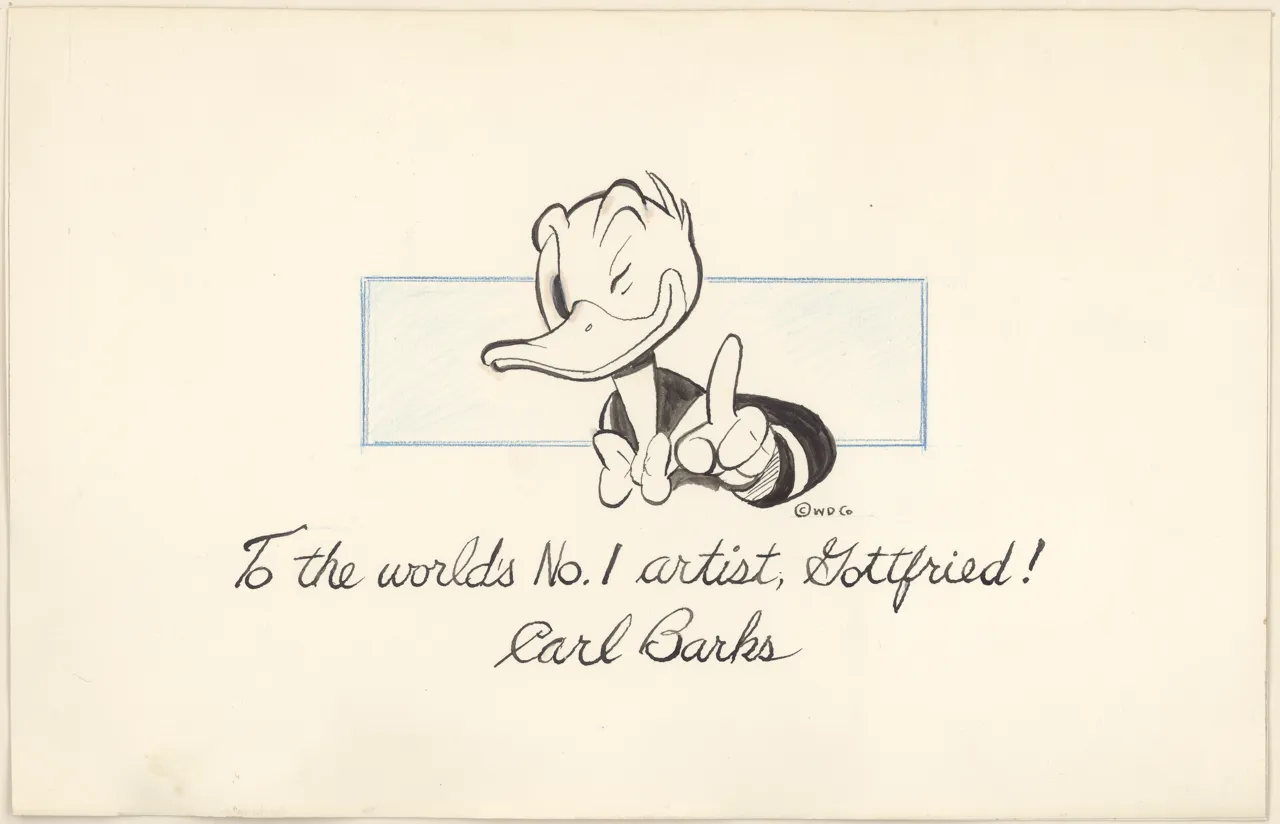
Michael Jackson: